Tuesday, November 29, 2011

Lesson 29 - Comparison

Learn Chinese, free online audio courses
Are those two the same? He's taller than me. Grammar, Examples and Exercices.
Lesson 29
· Conversation 1 : Are those two the same?
· Conversation 2 : He's taller than me.
· Conversation 3 : What time does your shop close?
· Grammar
· Exercises : Substitution Drill
Conversation 1 : Are those two the same?
Translation
- I want to buy a cloth for my child.
- What kind do you want to buy?
- That kind. Are this one and that one the same?
- No. This one is an import.
Conversation 2 : He's taller than me.
Translation
- Are those two the same size? ( This one is as big as that one? )
- Yes, all are medium size. Is your child taller than you? Is he fat? ( Does he grows fat? )
- I'm 1m68 tall. He's 5 centimetres taller than me. He is not as fat as me, thinner than me. Medium size is a little small on him. ( He wear medium size a little small. )
- Large size should be a good fit for him. ( He wears large size, quite suitable. )
Conversation 3 : What time does your shop close?
Translation
- What time does your shop close?
- 9. We close later than others.
Grammar
Comparison : the same
The construction 跟 (gēn) + 一样 (yí yàng) can be used to compare two things that are either identical or similar. 
A 跟 B 一样 adjective
Examples:
这件 跟 那件   一样 大? ( This one and that one are as big. )
这件 跟 那件 不 一样 大? ( This one and that one are not as big. )
Comparison
The preposition 比 (bǐ) may be used to express comparison between two things. 
A 比 B adjective
Examples:
我 比 你 高。 ( I'm taller than you. )
他 比 你 胖。 ( He is fatter than you. )
爸爸 比 妈妈 高。 ( Dad is taller than Mum. )
Comparison (+ degree)
A complement of degree can be added after the adjective. 
A 比 B adjective + degree
Examples:
我 比 你 搞 五公分。 ( I'm 5cm taller than him. )
他 比 我 胖 一点儿。 ( He is a little fatter than me. )
Verbal comparison
比 may also be used to express comparison in sentences with a verbal predicate. 
A verb 得 比 B adjective (+ degree)
Examples:
他 跑 得 比 我 快。 ( He run faster than me. )
我们 关 得 比 别人 晚。 ( We close later than others. )
他 长 得 比 我 高 很多。 ( He "grows" much taller than me. )
Exercises : Substitution Drills

Sunday, November 27, 2011

Lesson 28 - Sports Activities

 Learn Chinese, free online audio courses
What's your favorite sport? Can you play football? Grammar, Examples and Exercices.
Lesson 28
· Conversation 1 : Do you take exercise everyday?
· Conversation 2 : What's your favorite sport?
· Conversation 3 : Can you play football?
· Conversation 4 : You are a football fan?
· Grammar
· Exercises : Substitution Drill
Conversation 1 : Do you take exercise everyday?
Translation
- Do you take exercise everyday?
- Yes. I really like sports.
Conversation 2 : What's your favorite sport?
Translation
- What's your favorite sport?
- I like playing basketball and swimming.
- How good are you at basketball.
- Im not that bad, I swim also pretty good.
Conversation 3 : Can you play football?
Translation
- Can you play football?
- No, but I like to watch football games.
Conversation 4 : You are a football fan?
Translation
- You are a football fan?
- Yes, I go to the stadium every sunday. And if I can't buy a ticket, I watch TV.
- Is the ticket expensive. How much for one?
- No, about 20 Yuans.
Grammar
Revision: the complement of degree 
SubjectObject + Verb + 得 adjective 
Examples:
你 篮球 打 得 怎么样? ( How good do you play basketball? )
我 篮球 打 得 不错? ( I play basketball not bad. )
Revision: the potential complements 得 or 
SubjectVerb + 得 不 Verb + Object 
Examples:
我 买 不 到 球票。 ( I could not buy a ticket. )
我 买 得 到 球票。 ( I could buy a ticket. )
Phrase structure, if... then.
如果 (rúguǒ, if)... 就 (jiù, then)... occurs in conditional complex sentences. 
Examples:
我如果 买不到球票,就看电视。 ( If I can't buy a ticket, then I'll watch TV. )
如果 天气不好,就不去。 ( If the weather is bad, then don't go. )
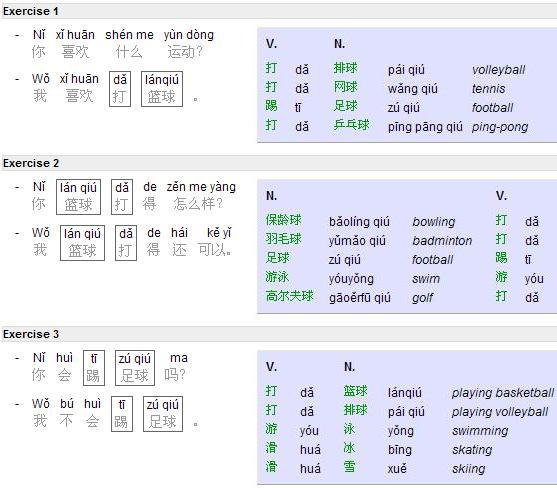
Exercises : Substitution Drills

Saturday, November 26, 2011

Lesson 27 - Climate, Weather

Learn Chinese, free online audio courses
What will the weather be tomorrow? What will be the temperature? Beijing weather. Grammar, Examples and Exercices.
Lesson 27
· Conversation 1 : What will the weather be tomorrow?
· Conversation 2 : What will be the temperature?
· Conversation 3 : Is winter in Beijing cold?
· Conversation 4 : What about spring and autumn?
· Grammar
· Exercises : Substitution Drill
Conversation 1 : What will the weather be tomorrow?
Translation
- It's raining. How will be the weather tomorrow?
- The weather forecast said: tomorrow is a sunny day.
- Will it be windy ( tomorrow will there be wind ) ? Will it be cold?
- Windy. And a little cool in the morning.
Conversation 2 : What will be the temperature?
Translation
- What will be the temperature tomorrow?
- The highest temperature will be 5 degrees, the lowest 1 below zero.
Conversation 3 : Is winter in Beijing cold?
Translation
- Is winter in Beijing cold?
- Extremely cold. And sometimes It snows.
- Is the summer hot? Does it rain often?
- Very hot, it rains frequently in July and August.
Conversation 4 : What about spring and autumn?
Translation
- What about spring and autumn?
- Spring is often windy and (the air) also very dry. Autumn is nice and cool, neither cold nor hot.
Grammar
Emphasis on adjectives using 极了
The suffix 极了 (jí le) is placed after adjectives. 
Examples:
天气 冷 极了。 ( The weather is extremely cold. )
今天 热 极了。 ( Today is so hot. )
东西 贵 极了。 ( Things are extremely expensive. )
Phrase structure "nor... neither..."
The structure ... 也不... can link up two adjectives or two verbs. 
Examples:
今天 不 冷 也不 热。 ( Today is neither cold nor hot. )
故宫 不 大 也不 小。 ( The Forbidden City is neither big nor small. )
我 不 喝酒 也不 吸烟。 ( I don't smoke nor drink. )
Exercises : Substitution Drills